
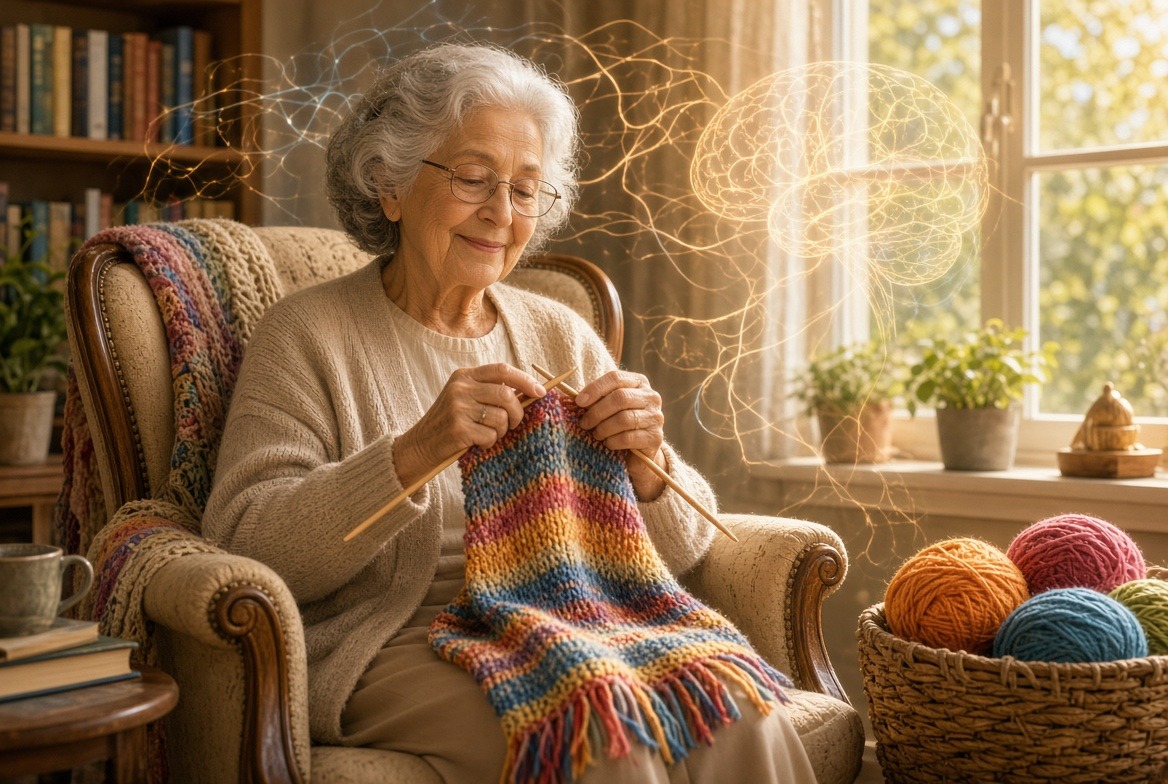
Your Grandmother Was Right All Along: Knitting Might Be One of the Best Things You Can Do for Your Brain
There’s a short Facebook reel floating around that drops a surprisingly cheerful bombshell: one of the most effective tools doctors have found for cutting dementia risk nearly in half is… knitting.
Yes. The same activity your grandma did while watching daytime TV and muttering about the neighbors. She was running a free brain gym the whole time.
Researchers tracking older adults found that people who regularly knitted, crocheted, or did similar handcrafts showed significantly lower rates of cognitive decline. In some groups, the difference in dementia risk was close to 50 percent compared with people who didn’t do these kinds of activities. That’s not a small number.
Why does something so simple work so well?
Knitting is sneaky. It looks peaceful, but under the surface your brain is doing a full-court press:
• Your hands are coordinating fine motor movements.
• You’re counting stitches and following (or inventing) patterns.
• Working memory is keeping track of where you are in the sequence.
• You’re problem-solving every time you drop a stitch or realize the sleeve is somehow longer than the body.
• Creative decision-making kicks in when you choose colors or modify a pattern.
It’s like CrossFit for your neurons, except you get to sit down and end up with a scarf.
Over time, this kind of multi-region workout appears to build what researchers call “cognitive reserve”—an extra mental buffer that helps the brain keep functioning even when age-related changes start to show up. The longer and more consistently you do it, the stronger that buffer seems to get.
Caregivers get a bonus, too. Chronic stress is rough on the brain. Having a repetitive, absorbing, slightly meditative hobby is one of the better-studied ways to push back against that wear and tear.
The fun part
You don’t need to become a competitive sweater Olympian. Even moderate, regular practice helps. Start with the easiest possible project (a dishcloth is a noble first goal). Make something ugly on purpose. Join a local knitting group and discover the quiet joy of complaining about yarn prices with strangers who get it.
And if someone gives you side-eye for pulling out needles in public, smile and say, “I’m reducing my dementia risk. What’s your strategy?”
Science is still sorting out exact mechanisms and effect sizes, and no single hobby is a magic shield. But the evidence is clear enough that “pick up a pair of needles” is starting to look like genuinely useful advice — the kind of advice that also happens to be cheap, portable, and capable of producing socks.
So the next time you see someone quietly knitting in a waiting room, give them a respectful nod. They’re not just making a hat. They’re running maintenance on their brain.
The Guide