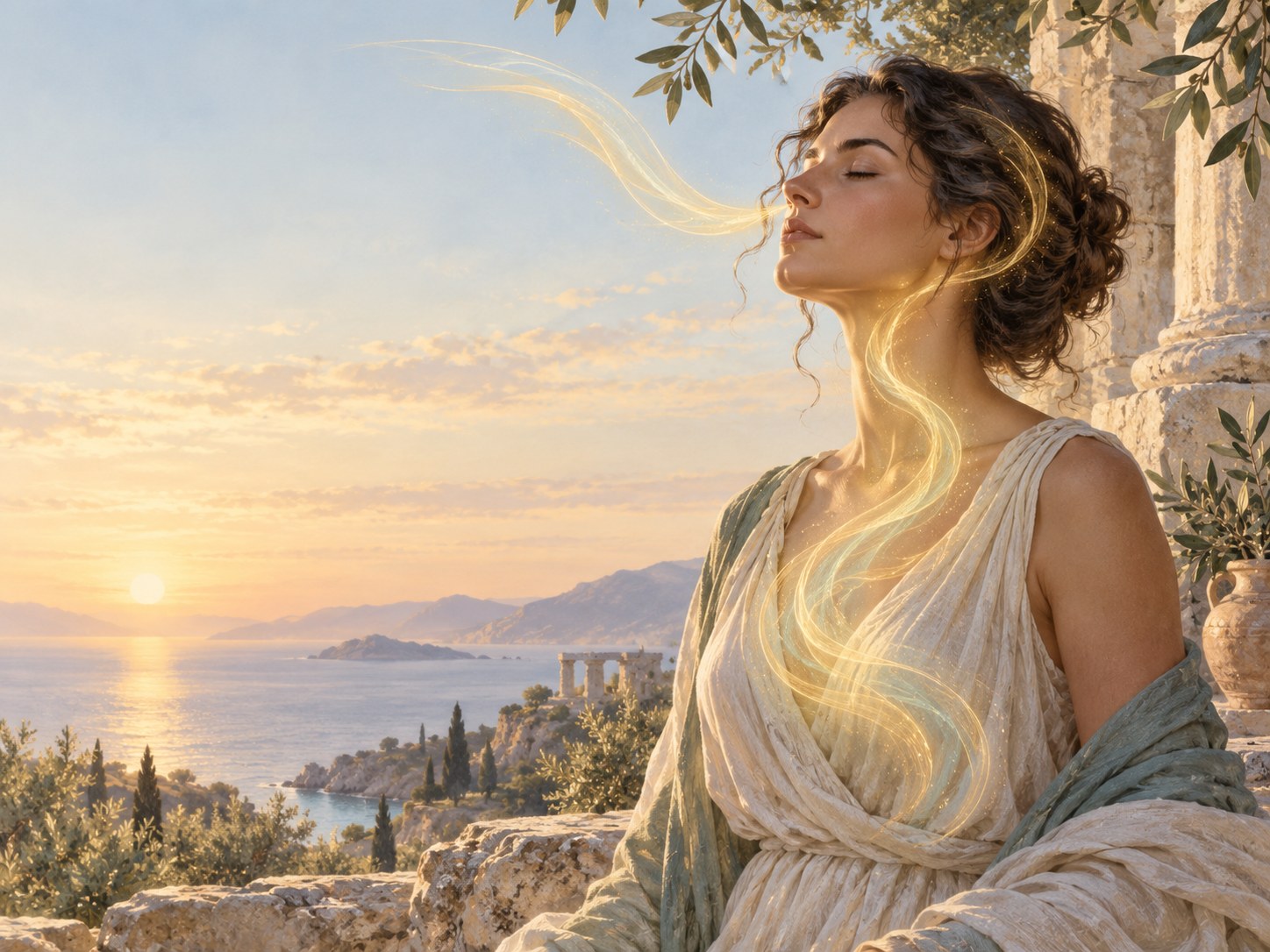
How Galen’s concept of pneuma connected nourishment, vitality, consciousness, and the breath of life
Breathing is so natural that we rarely stop to consider its mystery. From our first breath to our last, air moves continually between the inner world of the body and the world around us. We can survive for weeks without food and days without water, but only minutes without breath.
To the ancient Greek physician and philosopher Galen of Pergamum, breath was far more than air entering and leaving the lungs. It was part of a vital substance called pneuma—a Greek word that can mean breath, air, wind, or spirit.
Galen lived during the second century CE and became one of the most influential physicians in history. Building upon ideas associated with Hippocrates, Plato, Aristotle, and other ancient thinkers, he developed a comprehensive system for explaining how the body was nourished, animated, and guided by consciousness.
Pneuma: The Breath of Life
In Galen’s time, pneuma was not merely a poetic symbol. It was believed to be a real, life-sustaining substance that entered the body through breathing and was transformed by the organs.
Galen described three forms of pneuma, traditionally translated as the natural spirit, vital spirit, and animal or psychic spirit. Each was associated with a principal organ and a different level of human functioning.
Rather than viewing the body as a collection of separate parts, Galen imagined a living system in which nourishment, blood, breath, heat, sensation, movement, and thought were continually connected.
The Natural Spirit: Nourishing the Body
The first and most basic form was the natural spirit, or pneuma physikon, associated with the liver.
Galen believed that food was partially digested in the stomach and then carried to the liver. There it was transformed into blood infused with natural spirit. This nourishing blood traveled through the veins to support the body’s physical growth, metabolism, repair, and reproductive functions.
In this ancient model, the liver served almost like the roots of a tree. It received nourishment from the earth—in the form of food—and transformed it into something the entire body could use.
Although modern medicine describes digestion and metabolism very differently, Galen recognized an important truth: what we take into the body becomes part of us. Food supplies the materials required to build cells, produce energy, repair tissue, and sustain life.
The Vital Spirit: Feeding the Inner Flame
The second form was the vital spirit, or pneuma zotikon, associated with the heart.
Galen believed that blood from the liver traveled to the heart, where it encountered air brought in through the lungs. Through this meeting of blood and breath, the natural spirit was transformed into a more refined vital spirit.
This vital spirit was thought to regulate the body’s innate heat, physical energy, and capacity for action. It traveled through the arteries, carrying warmth and vitality throughout the body.
Galen viewed the heart as something like an internal furnace. Breathing helped feed this flame while also preventing it from becoming excessively hot. Exhalation carried away smoky or harmful waste produced by the body’s internal processes.
Modern science does not describe the heart as a furnace, but Galen’s imagery contains a remarkable intuition. We now know that oxygen taken in by the lungs enters the bloodstream and is carried to the body’s tissues. Cells use oxygen to help release energy from nutrients. Carbon dioxide, produced during this process, is carried back to the lungs and exhaled.
The ancient language of an inner flame is not scientifically exact, but it beautifully anticipates the connection among breath, circulation, warmth, and energy.
The Psychic Spirit: Breath Becomes Awareness
The third and most refined form was the animal or psychic spirit, known as pneuma psychikon. In this context, “animal spirit” did not refer to animals. The term came from a word associated with the soul, animation, and the ability to move.
Galen believed that vital spirit traveled from the heart to a network of blood vessels at the base of the brain. There it was refined into psychic spirit and stored within the brain’s ventricles.
According to his model, this spirit traveled through hollow nerves and made sensation, voluntary movement, memory, imagination, and rational thought possible. The brain did not merely control the body; it transformed vital energy into conscious experience.
Modern neuroscience has shown that nerves are not hollow channels carrying pneuma. They transmit information through electrical and chemical signals. Even so, Galen correctly recognized the brain and nerves as essential to sensation, movement, and thought—an important insight during an age when others placed the center of consciousness primarily in the heart.
A Journey from Matter to Mind
Galen’s three spirits can be understood as stages in a continuous journey:
- The liver transformed nourishment into the natural spirit that supported the physical body.
- The heart combined blood and air to create the vital spirit that produced warmth and active life.
- The brain refined this vitality into the psychic spirit responsible for sensation, movement, and thought.
In Galen’s worldview, body, breath, and consciousness were not separate realities. Food became blood, blood received breath, and breath-supported vitality became the power to perceive and act.
The system was anatomically mistaken, but its underlying question remains profound: How does physical matter become a living, feeling, thinking human being?
Science can explain many of the mechanisms involved, yet the experience of being alive still fills us with wonder.
Breath as a Meeting Place
Ancient cultures often connected breath with life and spirit. The Greek pneuma, Latin spiritus, Hebrew ruach, and Sanskrit prana can all carry meanings related to breath, wind, spirit, or vital life.
This does not mean that these traditions taught identical ideas. Each arose from a different cultural and philosophical setting. Yet they shared an awareness that breathing occupies a special place in human experience.
Breath happens automatically, but we can also influence it consciously. It therefore stands at the meeting place between processes we control and those the body performs without our permission.
When frightened, we may hold our breath. When anxious, breathing can become rapid and shallow. When relieved, we sigh. When peaceful, the breath often becomes slower and easier. Our emotions alter our breathing, and changing the way we breathe can, in turn, influence how we feel.
Modern research explains this relationship through the nervous system rather than through pneuma. Slow, comfortable breathing—particularly when the exhalation is gentle and unforced—may help reduce arousal and support a calmer state. This does not make breath a cure for every illness, but it does make it a practical way to reconnect with the present moment.
Listening to the Breath
We do not need to accept Galen’s ancient physiology to appreciate the wisdom behind his fascination with breath. He understood that life depends upon constant exchange. We take in nourishment and air, transform them within ourselves, use their energy, and release what we no longer need.
The next time you pause, take a moment to notice your breathing without trying to perfect it. Feel the air entering the nose, the chest and abdomen responding, and the breath returning to the world.
Inhale gently.
Pause naturally.
Exhale without force.
With every breath, the body participates in a rhythm far older than any medical theory. The ancients called it pneuma. Modern science describes oxygen exchange, circulation, cellular metabolism, and nervous-system regulation. Spiritual traditions may speak of life force or sacred breath.
Each language offers a different window into the same extraordinary reality: breath is the quiet companion of life. It nourishes the body, influences the mind, and reminds us that we are never entirely separate from the living world around us.